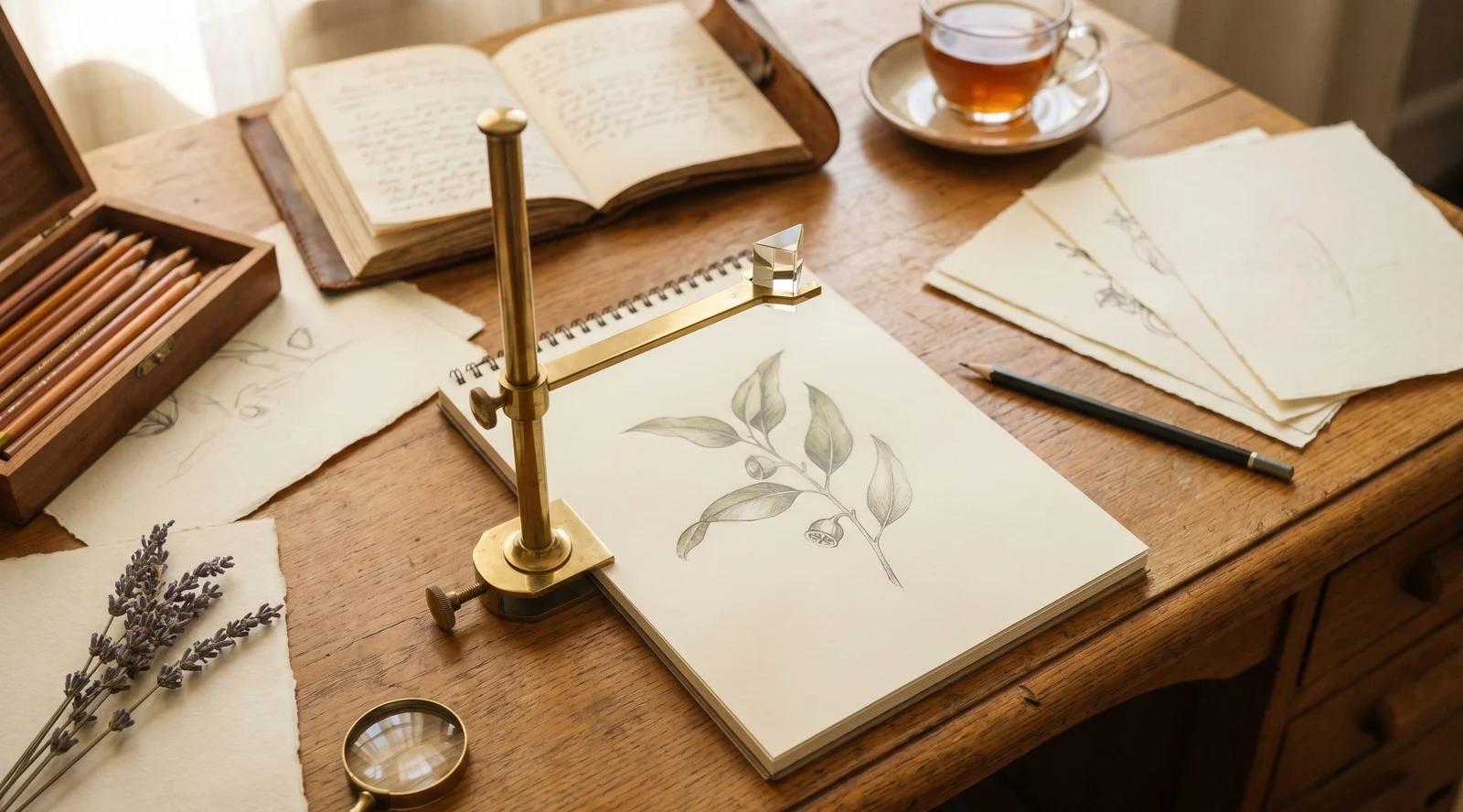
The camera lucida is the most influential drawing tool you have probably never seen. A small prism on a brass arm, patented in 1807, it lets an artist look down at a sheet of paper and see a faint, ghostly image of the scene in front of them — floating on the page, exactly where the pencil is going. Trace the outline, look up, and the rest of the drawing falls into place.
For most of the 19th century it was carried in the pockets of naturalists, architects, and portrait painters. Then it almost vanished. In 2001 David Hockney argued that half the great Renaissance masters had been using one (or something close) all along. And today, a free app and a phone do the same trick for free.
Here is what it is, who used it, and how to try it yourself.
What it is — in one paragraph
A camera lucida (Latin: "light chamber") is an optical drawing aid. It is not a camera; it does not record anything. It is a small prism — or, in later models, a half-silvered mirror — held on a flexible arm above a sheet of paper. The artist looks down through the prism and sees two things at once: the paper, and a faint reflection of whatever the prism is pointed at. The two images appear superimposed. Trace the reflection. That's it.
It was patented by William Hyde Wollaston, a Cambridge polymath, on December 17, 1807. Wollaston had a knack for inventions you could fit in a coat pocket — he also discovered palladium and rhodium, and built the first practical periodic-pressure steam engine. The camera lucida was his rent-paying side project.
How it works — the prism trick
The original Wollaston design uses a four-sided glass prism. Light from the scene enters one face, bounces off two internal faces by total internal reflection, and exits at the bottom, traveling down toward the paper. The artist's eye looks through that same exit face, slightly off-axis, and sees both — the real paper and the reflected scene — in perfect optical superposition.
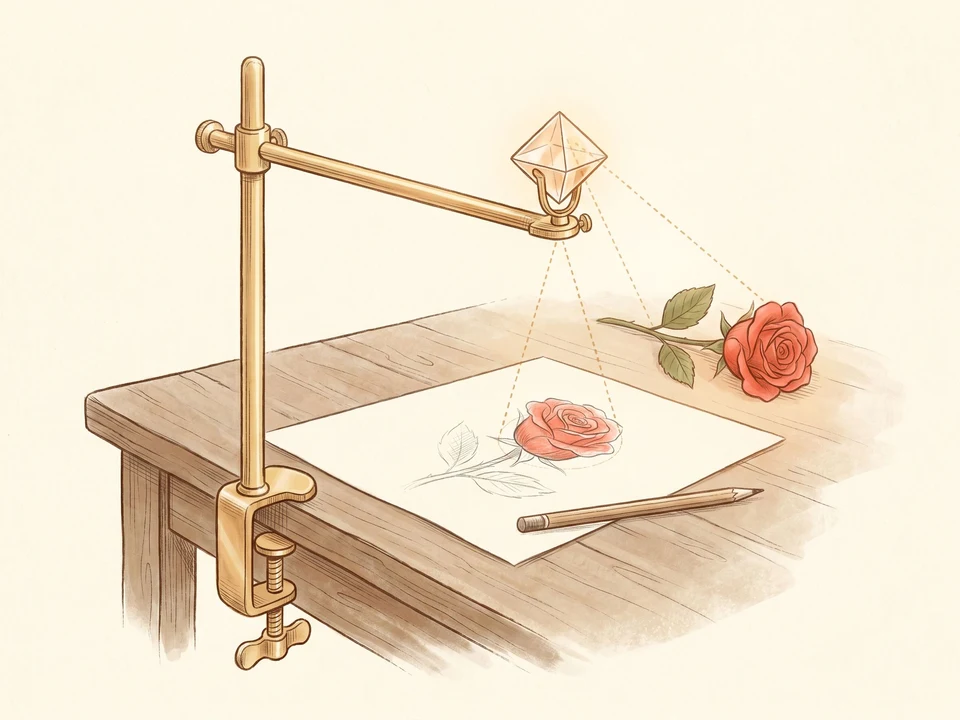
It is a strangely intimate device. You see your hand, your pencil, and the world all in one plane. Move your head an inch and the reflection shifts. Hold still and trace.
A short history of who used it
For the first fifty years of the 19th century the camera lucida was the iPhone of field illustration. It was cheap, portable, and worked anywhere with daylight. Three kinds of artists were obsessed with it:
Naturalists and botanists. The Bauer brothers, Ferdinand and Franz, produced thousands of plant illustrations for Kew Gardens and the Linnean Society — every one a study in geometric exactness, every one traced through a prism. Camera Lucida and Vasculum were the shorthand for a working botanist's kit.
Architects and surveyors. Isambard Kingdom Brunel sketched the Clifton Suspension Bridge through one. Charles Eastlake, soon to run the National Gallery, used his on Italian tour. Architectural drawing plates from the 1820s through the 1860s are full of perspective exercises that would have taken weeks freehand — and which the prism collapsed into hours.
Portrait painters. Jean-Auguste-Dominique Ingres, the Neoclassical master who painted the Grande Odalisque, is the most famous example. He used a camera lucida for many of his preparatory portrait drawings, which is why his sitters appear with that eerie, mathematical precision — the silhouettes are not drawn so much as transcribed. Ingres never wrote about it openly. The historian Martin Kemp had to piece it together from the surviving instruments and the geometry of the drawings themselves.
The camera lucida declined when photography arrived. Daguerre's 1839 process did the same job in seconds, automatically, with no skill required. Within a generation, the prism was a curiosity.
The Hockney thesis — and the controversy
In 2001 the painter David Hockney published Secret Knowledge: Rediscovering the Lost Techniques of the Old Masters. The argument: not only did 19th-century artists use the camera lucida, but 15th- and 16th-century painters — Vermeer, Caravaggio, Ingres, Lotto — had been using some optical device (camera lucida, camera obscura, concave mirror) at least a century earlier than the official record allows.
His evidence was visual. Hockney went through hundreds of Old Master paintings and pointed at the moments when the geometry suddenly becomes too perfect — the foreshortening on a chair leg, the identical-pattern carpet repeated at different scales, the lute neck that "snaps" into focus at a single distance. The Hockney–Falco thesis (developed with the physicist Charles Falco) argues these are tell-tales of optical aid.
Art historians pushed back. Some claimed the evidence was overcooked; others that Hockney was reading a 21st-century pictorial mindset backwards. The dispute is unresolved, and probably unresolvable — the technique would leave little physical evidence. But the book made the camera lucida famous again, twenty years before phone apps revived it for real.
Barthes's Camera Lucida — the other one
If you searched for "Camera Lucida" hoping for an art-tool article and ended up at Roland Barthes, you are not alone. The semiotician's 1980 book La Chambre claire — published in English as Camera Lucida: Reflections on Photography — is his last and best-known work, written shortly before his death.
Barthes uses the title as a deliberate inversion of camera obscura. His subject is not the drawing tool, but the strange way a photograph holds a fragment of the real and offers it back to the viewer. That-has-been, in his phrase. The book invents the terms studium (general interest a photo carries) and punctum (the specific detail that pricks you).
It is one of the foundational texts of photography theory. It has nothing — directly — to do with Wollaston's prism. But because the shared title sends Barthes's PDF to the top of Google for "camera lucida book," people who came looking for a drawing aid often find themselves reading semiotics instead.
How to build your own camera lucida
You do not need to spend $200 on a brass reproduction. There are three DIY approaches, each at a different point on the cost-vs-quality curve.
The cheap glass method. A small piece of clear glass, held at a 45-degree angle above your paper, will produce a faint reflection of whatever is in front of it. A picture frame with the backing removed works fine. Tape it to the edge of your desk at the right angle, point a lamp at your subject (the reflection needs to be brighter than the paper), and trace what you see. It is wobbly, dim, and effective.
The half-mirror method. A piece of dichroic film or a beam-splitter glass — about $15 from an optics supplier — produces a brighter half-reflection. Mount it on a small stand at 45 degrees over the paper, position your subject in front of the stand at eye level. This is essentially how the NeoLucida ($65 from the same designers as the Bigidesign camera lucida iPhone app) is built. You can build the same thing for under $20 with a clamp, a piece of beam-splitter glass, and some 3D-printed brackets.
The prism method. A genuine four-sided right-angle prism, like the 1807 design, runs $80–$200 from edmund-optics or science suppliers. Mount it on a flexible arm, clamp the arm to your desk, and you have the original Wollaston instrument. The image is the brightest of any DIY method and the closest to what Ingres saw.
The smartphone equivalent
In the last few years, the camera lucida has come back — not as glass and brass, but as augmented reality. The principle is identical: two images, superimposed, with the artist tracing one onto paper. The difference is that the phone replaces both the prism and the mounting hardware. Open an AR drawing app, point the phone at the paper, drop a reference image into the camera view, and the same optical illusion appears on the screen.
A phone-based camera lucida app has three things the 1807 version did not: brightness (the reference is on a backlit screen, not a faint reflection), arbitrary subject matter (any photo, AI generation, or pre-made template, not just whatever you can sit next to), and no special skill required (no head-locking, no prism alignment).
ARTrace is one such app. Drop in a photo, project it through the camera onto your paper, trace by hand. Same trick Wollaston patented; zero brass.
Is it cheating?
The argument that the camera lucida is "cheating" assumes drawing is a test of innate hand-eye coordination — and that any aid invalidates the result. This is a recent idea. For most of the history of Western art, drawing was a craft built on mechanical aids: grids, tracing paper, perspective frames, proportional dividers, the camera obscura, the camera lucida. The Old Masters used everything they could get their hands on, because the goal was the finished painting, not a proof of dexterity.
What the tool removes is the slow part — getting proportions right. What it leaves you is the interesting part: line weight, character, expression, color, story. Ingres still had to paint Ingres. A camera lucida cannot do that.
The same is true now. An AR overlay places the outline on your paper; the pencil work, the texture, the shading, the personality is all yours. If you would like to try it, we have a step-by-step tracing guide and a drawings-to-trace library full of beginner-friendly subjects.
Wollaston would probably have approved.