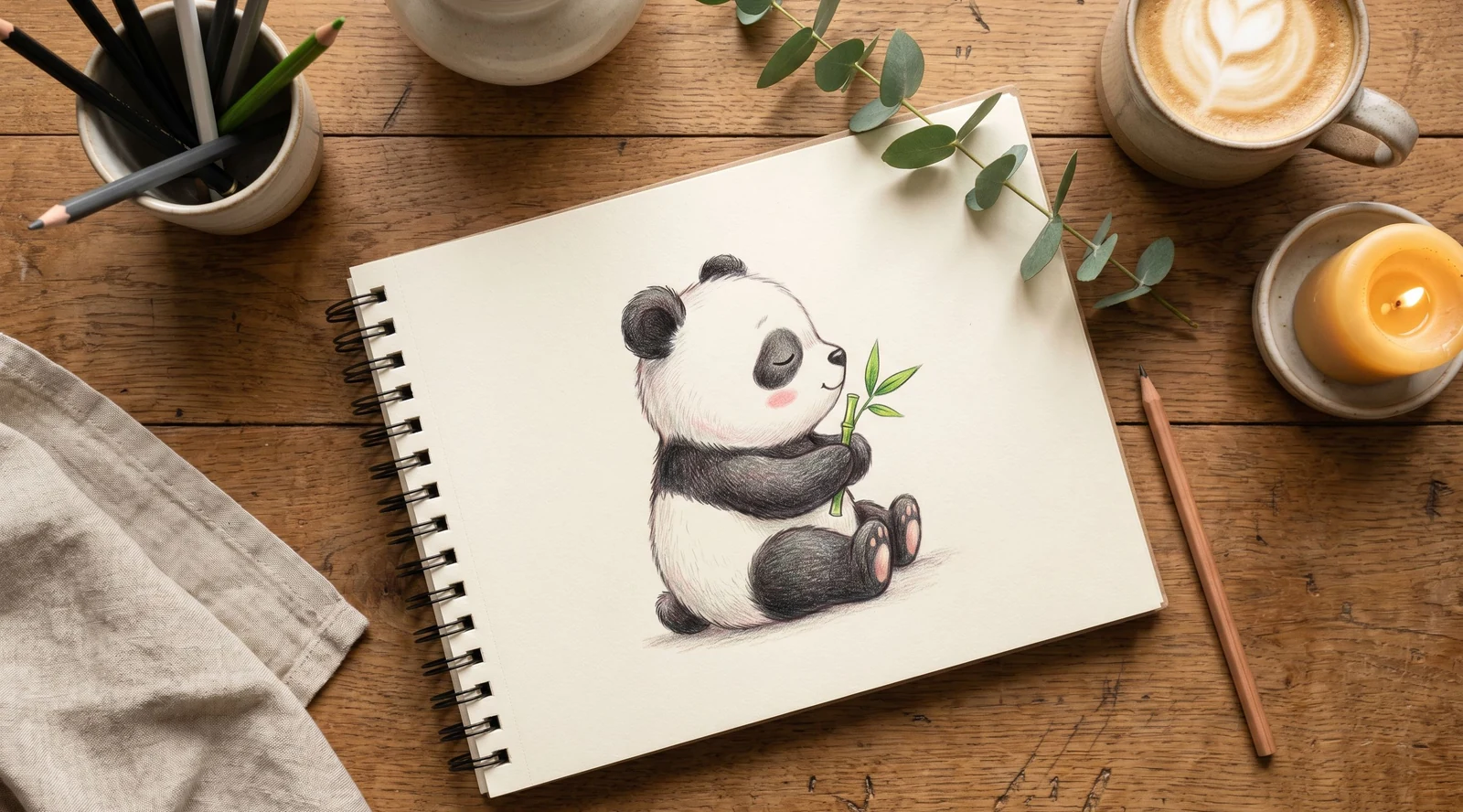
- Difficulty
- Beginner
- ● ● ○ ○ ○
- Time
- 30–40 min
- From blank page
- Steps
- 9
- Circle → black & white
- Best for
- Ages 6+
- Kids & adults
Grab these first
A pencil (HB or 2B), an eraser, plain paper, and colored pencils — black, soft gray, fresh green, and a hint of pink. A black fineliner is nice for the clean outline in step 5, but graphite alone works just fine.
Want a perfectly proportioned panda on the first try? Open the panda template in ARTrace and project it onto your paper through the AR camera. Your hand does the drawing; your phone holds the shape in place — a modern camera lucida in your pocket. More to trace once you finish? Browse the full drawings-to-trace library for ideas.
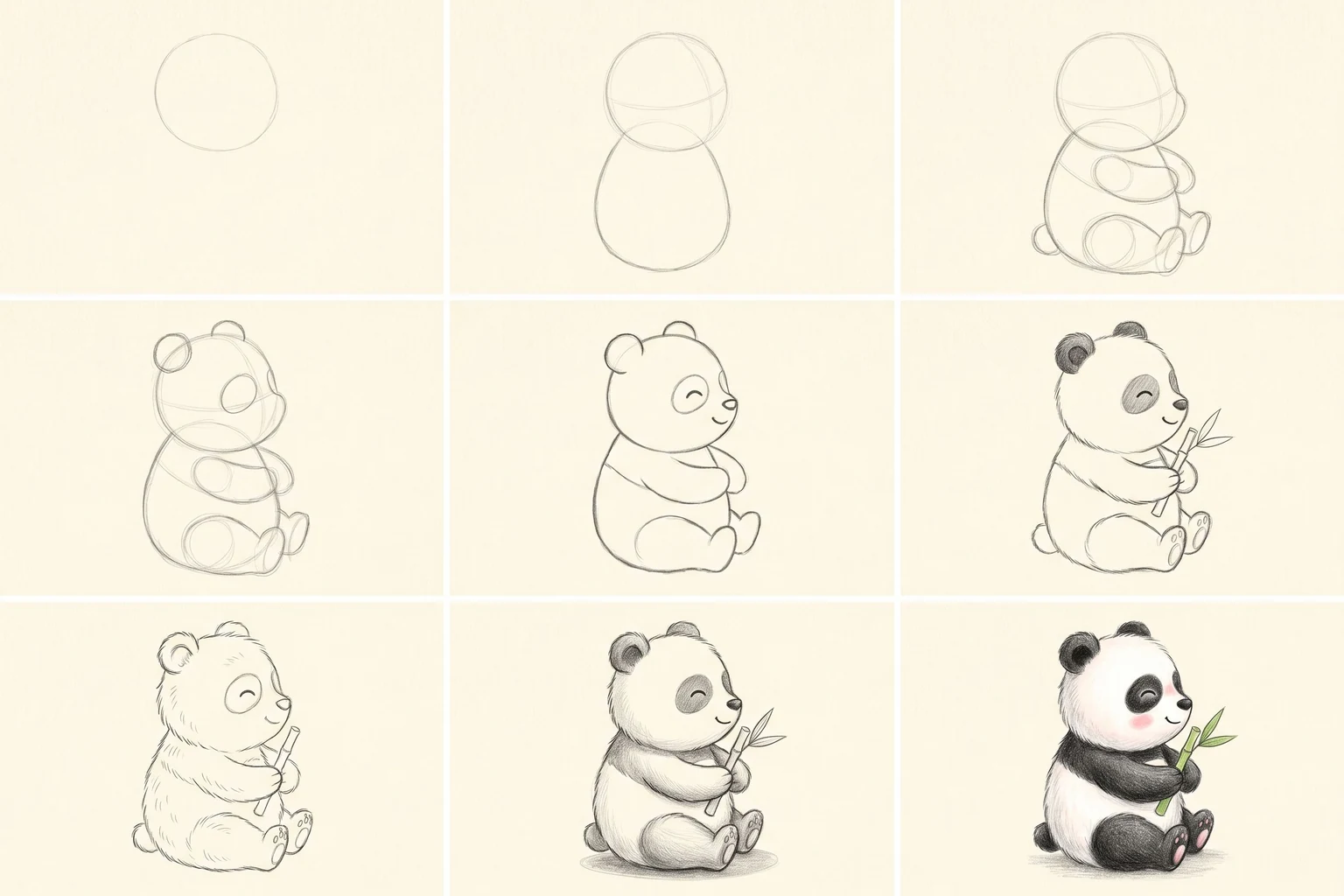
1. Round head circle
Draw one circle in the upper third of your page. That's the head. Keep the pencil loose and the line really light — this is pure construction and you'll erase most of it later. Pandas have lovely round heads, almost a perfect circle, slightly squashed at the top where the ears will sit.
Don't worry about getting the circle "right". A slightly egg-shaped or wobbly circle reads more naturally than a perfect one, and gives your panda character.
2. Chunky oval body
Right below the head, and overlapping it just slightly, draw a larger chunky vertical oval. This is the body. Pandas are stocky — think of a fluffy potato wearing a small head as a hat. If your body looks slimmer than the head, stretch it both wider and taller until it looks like a comically large belly.
3. Tucked legs and paws
Two short curves at the bottom of the body for the back legs, tucked forward like the panda is sitting on the ground. At the chest, two small round shapes for the front paws meeting in the middle. The whole silhouette should already say "sitting peacefully on the forest floor".
4. Ears and eye patches — instant panda
Two small round ears perched on top of the head. Then the magic move: two oval black eye patches that sit roughly where the eyes will go and wrap slightly outward and downward, like soft black sunglasses. The moment those go on, the rounded blob becomes unmistakably a panda.
5. Bring the face to life — and commit to a clean line
Two relaxed closed-curve eyes inside the patches (pandas always look like they're enjoying a snack), a tiny black nose at the center, a small smile underneath. Then trace the whole panda with one confident line and erase every single construction stroke. This is the moment the drawing tightens up.
6. Pop in the bamboo shoot
Between the two front paws, draw a thin vertical bamboo stalk with one or two narrow leaves at the top. Curve the paws gently around it so it looks held, not glued on. This is the panda's universal selfie pose — no panda illustration feels complete without one.
7. Hint at fluffy fur
Short, directional pencil strokes around the edges of the body, cheeks, ears, and shoulders. Follow the direction the fur grows — down along the sides, fluffy around the cheeks, soft along the back. A few separation lines on each paw to suggest toes, and a couple of texture marks on the bamboo so it doesn't read as a plain stick.
8. Shadows do the heavy lifting
Soft graphite shading under the chin, along one side of the belly, between the legs, and a touch under the bamboo. Then the single most important touch: a small oval shadow on the ground beneath the panda. It stops floating. It starts sitting.
9. Black, white, and a pop of green
Now the panda's signature palette. Deep black on the ears, the eye patches, the front legs, and the back legs. Leave the head and belly bright white — only a touch of soft gray for shadow tone. Soft pink on the cheeks and inside the ears. A clean fresh green for the bamboo with a slightly darker green along one side. Deepen the existing shadows a touch and sign your name.