- Difficulty
- Beginner
- ● ● ○ ○ ○
- Time
- 30–45 min
- Per animal
- Tutorials
- 7
- All in one place
- Best for
- Ages 6+
- Kids & adults
Grab these first
The supplies are the same for every animal in this guide:
- An HB or 2B pencil.
- An eraser.
- Plain paper — printer paper is fine; sketchbook paper is nicer.
- Colored pencils — at minimum: a warm brown, a soft pink, a black, and one accent color.
- A black fineliner for the clean outline step (optional).
Want a perfectly proportioned animal on the first try? Open any template in ARTrace and project it onto your paper through the AR camera. Your hand does the drawing; your phone holds the shape in place — a modern camera lucida in your pocket. More to trace once you finish? Browse the full drawings-to-trace library for ideas.
The shared skeleton
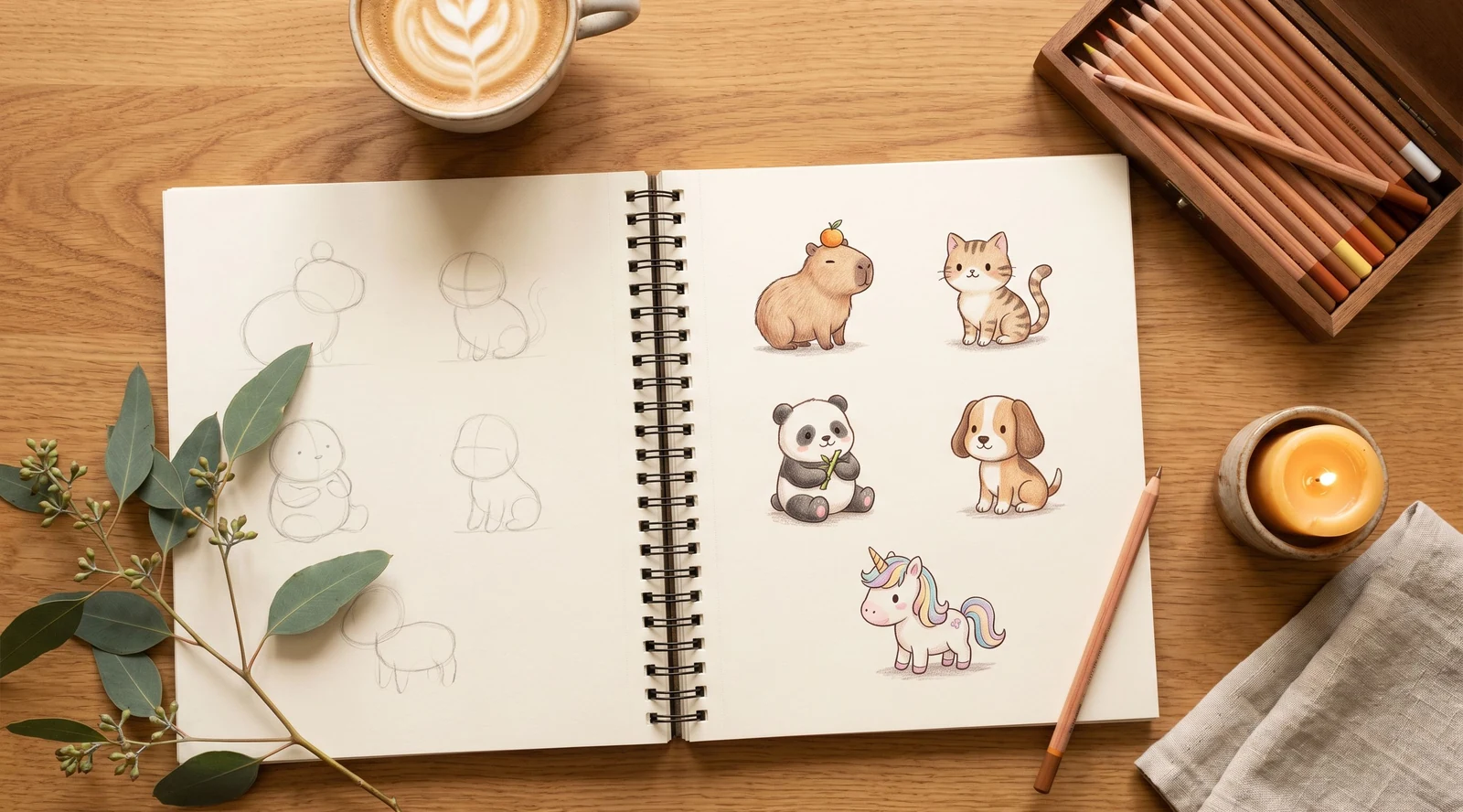
Every cute cartoon animal in this guide starts the same way:
- One circle for the head.
- One overlapping oval for the body.
- A few short curves for legs or tucked paws.
- Identifying features — ears, snout, tail, horn — added after the silhouette is in place.
- A clean outline drawn over the construction, then erase the pencil scaffolding underneath.
That's it. The capybara and the panda look like completely different animals, but the underlying shapes are nearly identical — what changes are the ears, the snout, the accessory on top, and the color palette.
The remaining shared steps — fur texture, shadows, and the final colored layer — are identical across every tutorial. Each one ends with a single colored cell where the same finished pencil drawing is filled in with soft colored pencil. No mystery; just five variations on a theme.
The capybara — two rectangles and an orange
The chunkiest of the bunch. Two stocky rounded rectangles instead of the usual circle-plus-oval, four very short legs, and a small orange between the ears as the signature touch.
Best for: memes, an internet-famous pose, anyone who wants maximum "I am vibing" energy in their drawing.
Time: 30–40 minutes.
The dog — circle, oval, four cylinder legs
The most classic of the five. One circle for the head, an oval for the body, four simple cylinder legs, two floppy ears, and a friendly muzzle. The clearest demonstration of the shared skeleton in action.
Best for: a first attempt, kids drawing alongside, anyone who wants a recognizable result on the very first try.
Time: 30–45 minutes.
The panda — black, white, and one bamboo shoot
The animal with the strongest color identity. The construction is a plump head circle plus a chunky vertical oval, but the oval eye patches are what instantly read as "panda" — not raccoon, not bear. And the bamboo shoot held between the front paws seals the pose.
Best for: anyone who likes the meditative quality of laying down black and white shapes. Also: anyone whose favorite color is "the absence of color".
Time: 30–40 minutes.
The cat — two circles and a tail
The fluffiest of the five. Same circle-plus-oval foundation, but with a long curled tail tucked in front, triangle ears that point straight up, and a relaxed smiling face. The loaf pose — universally recognizable, universally satisfying to draw.
Best for: cat people. Also: people who tried to draw a fox and ended up with a cat, which is fine, the cat is the better outcome.
Time: 25–35 minutes.
The unicorn — the same recipe with a horn
Two ovals (head and body), four stubby legs, a long flowing mane and tail, a spiraled horn, and a pastel-rainbow palette in the final step. This one demonstrates how easy it is to take the same skeleton into fantasy territory — just add the horn and pick a brighter color scheme.
Best for: anyone who's drawn realistic horses before and was disappointed by how much work that is. Cute unicorns are forgiving.
Time: 30–40 minutes.
The lion — a big mane on a little body
The chubbiest face in the whole guide. Same circle-plus-oval construction, but the fluffy round mane wrapped all the way around the head is what flips the silhouette from "kitten" to "lion king". A long curling tail with a tiny tuft on the end seals the personality.
Best for: kids drawing sessions, anyone who wants a noticeably warm tawny color palette, and anyone tired of drawing animals that all share the same gray-and-pink tones.
Time: 35–45 minutes.
The tiger — all stripes and a tiny smile
The wildest of the bunch and the one that needs the boldest hand. The construction is the same circle-plus-oval, plus four stubby legs and a curling tail. But the black stripes are the move — without them you've got a generic cub; with them you unmistakably have a tiger. Vary the stripe lengths and let a few of them wrap around the body so the silhouette feels three- dimensional rather than flat.
Best for: anyone who loves drawing high-contrast detail, kids who want their tiger to look genuinely fierce-but-cute, and anyone tired of pastel palettes.
Time: 35–45 minutes.
What to draw next
Once you've worked through two or three of these, you've internalized the shared skeleton — and that's the whole point of this guide. After that, the next steps depend on which direction interests you:
- Stay in the cute-animal lane. Try a fox (same as a cat but with pointier ears and a fluffier tail), a bunny (longer ears, a smaller body), or a bear (chunkier oval, smaller round ears). The recipe doesn't change.
- Step into botanical drawings. The rose tutorial and the sunflower tutorial use a different style — naturalistic colored pencil instead of cartoon — but the same 9-step progression.
- Skip the freehand entirely. When the construction feels like the hard part rather than the fun part, use ARTrace to project a reference onto your paper. Tracing isn't cheating; it's how you teach your hand the shapes your eye already knows.