- Difficulty
- Beginner
- ● ● ○ ○ ○
- Time
- 35–45 min
- From blank page
- Steps
- 9
- Circle → full color
- Best for
- Ages 6+
- Kids & adults
Grab these first
A pencil (HB or 2B), an eraser, plain paper, and colored pencils — warm orange, a deeper amber, rich black, and a touch of soft pink. A black fineliner is nice for the stripes in step 6, but a soft graphite pencil pressed firmly works just as well.
Want a perfectly proportioned tiger on the first try? Open the tiger template in ARTrace and project it onto your paper through the AR camera. Your hand does the drawing; your phone holds the shape in place — a modern camera lucida in your pocket. More to trace once you finish? Browse the full drawings-to-trace library for ideas.
1. Round head circle
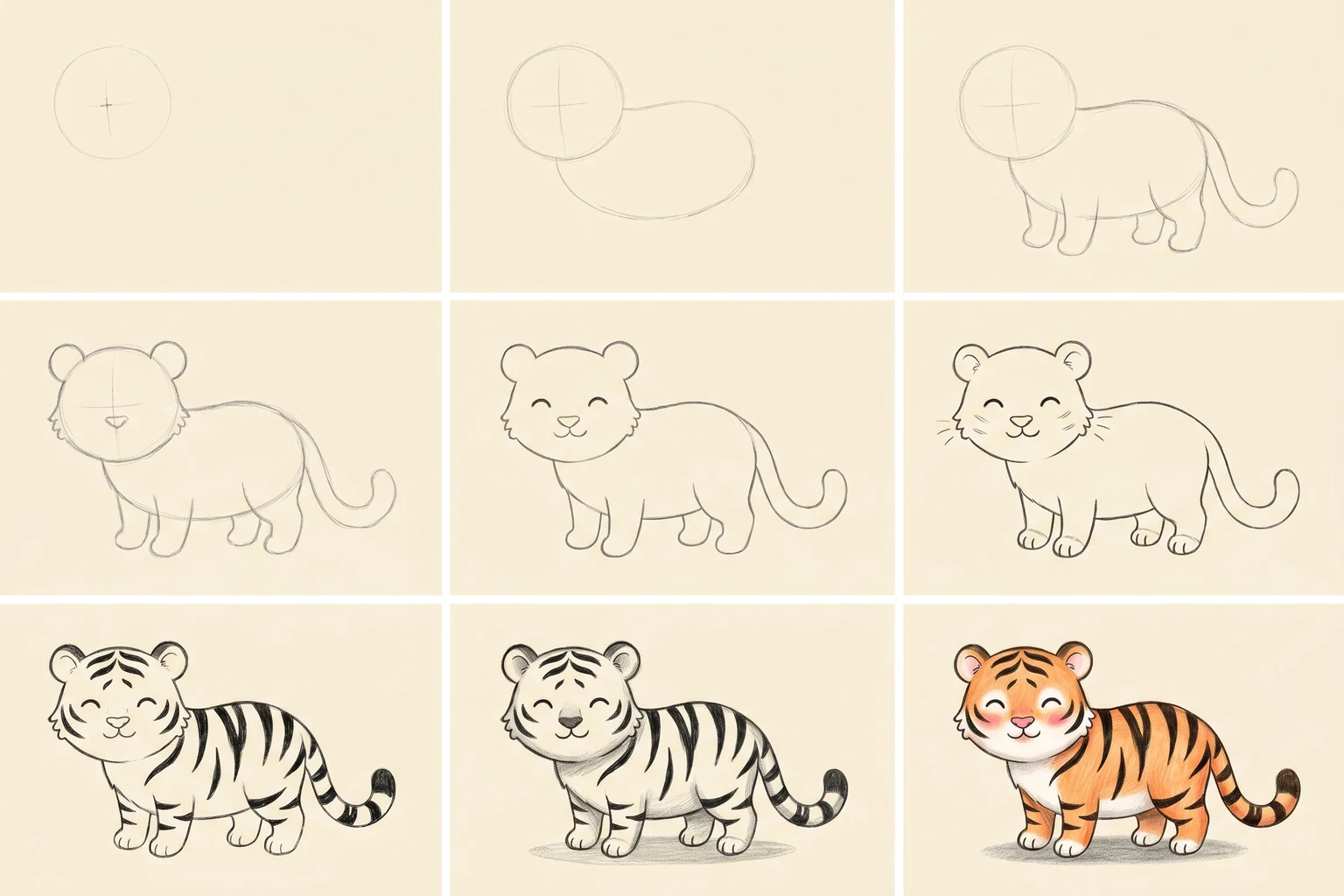
Draw one faint circle in the upper third of your page. That's the head. Press lightly — this is pure construction and you'll erase most of it later. Add a barely-visible cross inside: a vertical line for the center of the face, a horizontal line for the eye level. Those two crossing lines do all the placement work for you in step 5.
A perfect round shape is not the goal. A slightly egg-shaped circle gives the tiger more character once the ears and snout go on.
2. Chunky oval body
Right next to the head, slightly lower and to the right, sketch a wide horizontal oval. That's the body. Overlap the head circle just a touch at the neck so they read as one creature instead of two floating shapes. Cute cartoon tigers are stocky — make the body noticeably longer than the head is tall. Too slim and the silhouette ends up reading as a kitten in stripes.
3. Stubby legs and curling tail
Four short stubby legs poke down from the body — really short, just enough to read as legs. Then sweep that S-curve into a long curling tail behind the body, ending in a soft curl rather than a sharp point. The tail is half the personality of the drawing, so let it loop back on itself rather than trailing straight.
4. Ears, snout, cheek tufts
Two small rounded triangular ears sit on top of the head — not pointy like a cat's, more like soft rounded peaks. A tiny rounded snout in the center of the face, just below the construction crossbar. Then add the smallest hint of cheek tufts on each side of the head, like little fur ruffles. The moment the cheeks go on, the rounded blob starts to read unmistakably as a wild cat.
5. Bring the face to life
Two closed-curve happy eyes sit right on the construction crossbar, a tiny rounded nose at the center, and a small smile just underneath. Tigers in this style always look like they're about to nap in a sunbeam. Now trace the whole drawing with one confident line and erase every single construction stroke. This is the moment the tiger tightens up and starts looking like a finished sketch.
6. Whiskers and small details
Before the stripes go on, add the tiny finishing details that turn the silhouette from "round cub shape" into "specifically a tiger". Short whisker marks fanning out from each cheek. Two or three short separation lines on each paw to hint at toes. A small inner curve inside each ear to suggest depth. None of these are big moves, but together they make the clean line drawing feel done.
7. The signature tiger stripes
This is the move that does all the heavy lifting. Bold black stripes across the back, the sides, the head, and along the tail. Vary their length — a few short marks above the eyes, longer ones wrapping the body, narrowing bands ringing the tail. Stripes are slightly thicker near the spine and taper as they curve down the body. Press firmly with the pencil; these are the only really dark marks on the whole drawing. The cub becomes a tiger in this single step.
8. Shadows do the heavy lifting
Soft graphite shading under the chin, along one side of the belly, between the legs, and a touch under each side of the body where the legs meet. Then the single most important touch: a small oval shadow on the ground beneath the paws. It stops the tiger from floating. It starts him standing.
9. Warm orange color — the final flourish
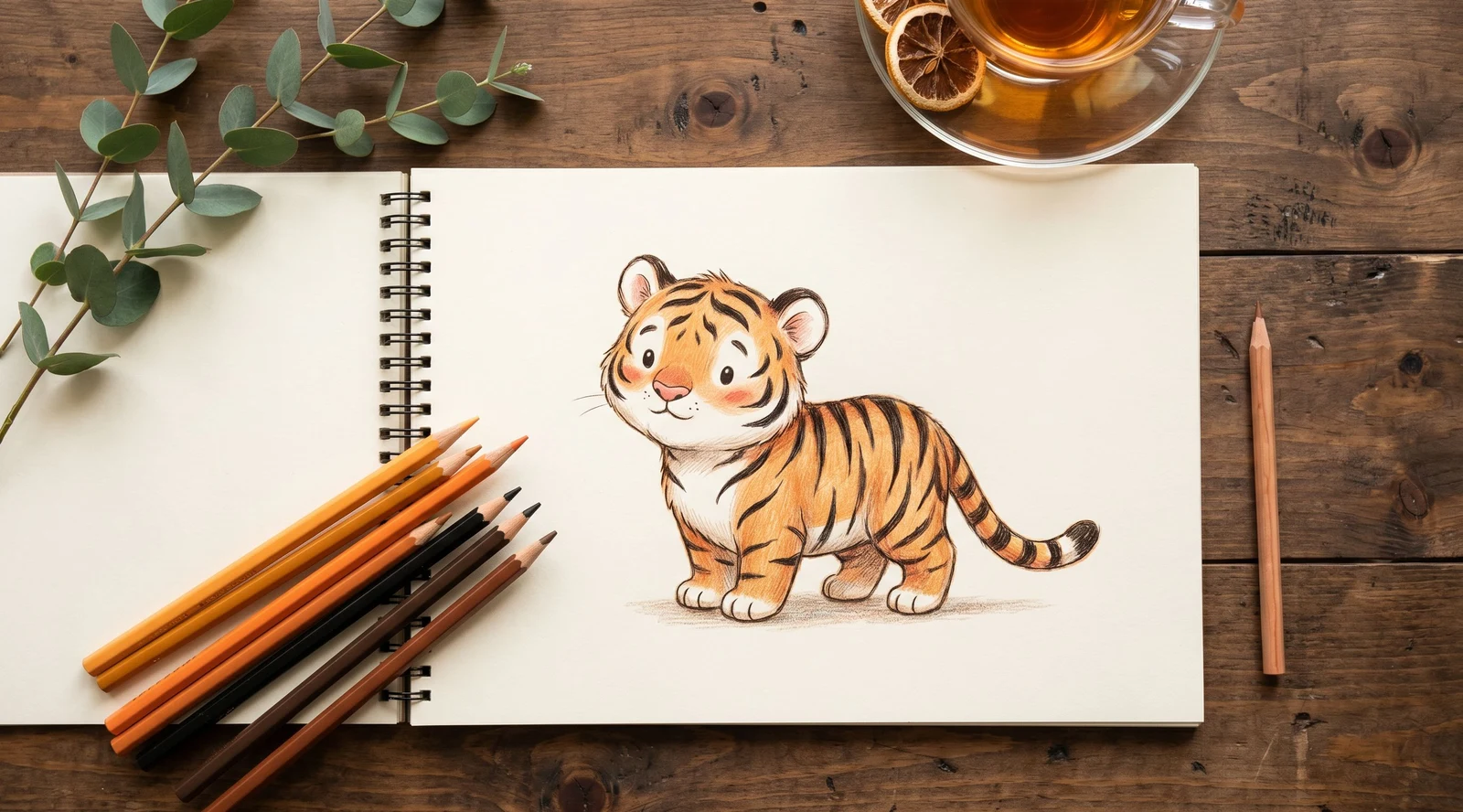
Warm orange across the body and face, slightly deeper on the back and along the top of the tail, softer on the cheeks and sides. Bold black layered over every stripe and the very tip of the tail. Leave the belly, the inner ears, the chin, and a strip around the muzzle bright white. A small pink nose. A hint of soft pink on the cheeks. Deepen the existing shadows a touch and sign your name.