ARTrace app iconARTrace
Part of: How to Draw Cute Animals — Seven Tutorials, One Skeleton
How to draw8 min read · Updated April 2026

How to draw a unicorn
that actually looks cute.

Two ovals, four little legs, a horn, and a pastel rainbow. Nine forgiving steps, no perfect lines required. By the end of this guide, you'll have a chibi unicorn worthy of taping to the fridge.

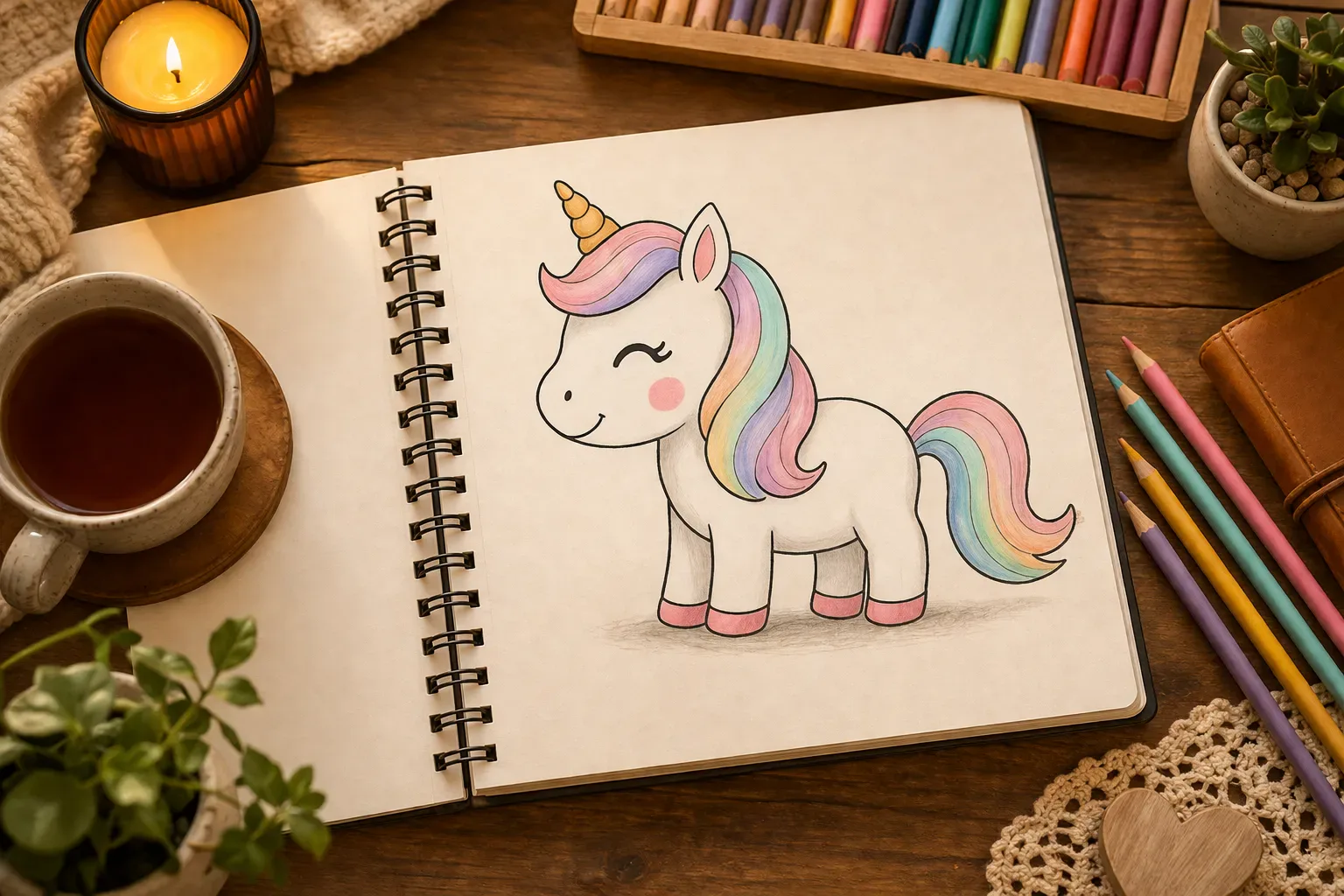
A finished pastel-rainbow chibi unicorn drawn in a sketchbook, surrounded by colored pencils, a candle, and a cup of tea
Supplies
  • HB or 2B pencil
  • Soft eraser
  • Black fineliner (0.3 mm)
  • Cream or white paper
  • Pastel pencils or watercolor
  • 10 minutes of patience ✨
Time
30m
Coffee-break sized
Level
01
Total beginner
Shapes
2+4
Ovals + legs

Forget anatomy. A chibi unicorn is just two friendly ovals stacked together — a head, a body — with stubby legs underneath. Once that's on the page, the rest is decoration: a horn, a mane, and finally the part you came here for, the rainbow.

Before you start

Lay your tools out left to right in the order you'll use them: pencil, eraser, fineliner, color. It saves you from rummaging mid-flow. Want a guaranteed-cute outline on the first try? Open the unicorn template in ARTrace and project it through your phone camera — your hand draws, the phone holds the proportions. More to trace once you finish? Browse the full drawings-to-trace library for ideas.

Part 1 · The skeleton

Two ovals, four legs.

Step 1.One big oval. The head.

Start with the head

Big rounded oval, upper-left of the page. Chibi proportions mean the head is the largest single shape on the unicorn — give it real estate. Light pressure on the pencil. This line is temporary.
Step 2.Smaller body oval, joined with a neck.

Drop in the body

A smaller oval below and slightly right of the head, joined with a short slanted neck. This pair already determines the pose: head looking left, body horizontal, weight evenly balanced.
Step 3.Four chunky little columns.

Four stubby legs

Underneath the body, drop four short, plump column-shapes. They should be roughly the same length — your unicorn is standing, not running. No hooves, no joints, no toes. Stubby is the goal.
Part 2 · The identity

From blob to unicorn.

Step 4.Horn + ears + tail outline.

Horn, ears, tail outline

The transformation step. Plant a short, chunky triangular horn on top of the head. Two small triangular ears flank it. Behind the body, sketch the long flowing tail as a single outline — no locks yet, just the silhouette. Suddenly, unmistakable.
Step 5.Closed lashed eyes, smile, clean black ink.

Face + clean outline

Closed-eye arc with long lashes, tiny smile, dot for the nostril. Then the brave part: erase every construction line and trace the unicorn with one confident black ink stroke. The scaffolding goes, the building stays.
Spot the change · step 4 → step 5

The whole unicorn just stopped being a sketch and became a drawing. The construction ovals are gone, the horn is committed, the face is on the page.

The construction lines are scaffolding. The clean ink outline is the building. You don't keep the scaffolding once the building is up.

Part 3 · The details

Mane, spiral, shadows.

Step 6.Wavy, separate locks down the neck.

The mane in flowing waves

From the top of the head down the neck, draw a wavy mane built from several distinct locks — little tear-drops or commas — rather than one solid mass. Still pure line art. Body and tail interior stay empty white.
Step 7.Spiral on horn, blush on cheek, tail strands.

Horn spiral & cheek blush

Three or four diagonal lines along the horn give you the classic twisted texture. A small round blush mark on the cheek adds personality in 2 seconds flat. A few flowing lines inside the tail show the strands. Still strictly black and white.
Step 8.Soft graphite + an oval ground shadow.

Shading + a ground shadow

Soft pencil, very light pressure. Shade the underside of the body, beneath the jaw, between the legs, under the mane, and under the tail. Then an oval shadow on the ground beneath the hooves. Without it, the unicorn floats. With it, it stands somewhere real.
Part 4 · The reward

Pastel rainbow time.

Step 9.Golden horn + pastel mane + pink hooves.

Color, gently

Soft pressure, thin layers, lots of overlap. The horn is golden yellow. The mane and tail are pastel pink, mint, lavender, and peach — let them blend at the edges. Pink hooves, pink inner ears, a pink blush. The body itself stays white with only the faintest warm shading.
The pastel rainbow palette
Soft. Warm. No saturation past 40%.
Horn
#F4C758
Pink
#F9C7D2
Mint
#BFE6D6
Lavender
#D4C7EC
Peach
#FAD2B8
Hooves
#F2A6B5
What's next

Same skeleton, four new looks.

  • Pegasus
    Add wings at step 4
  • Alicorn
    Wings + horn together
  • Plain pony
    Skip steps 4 & 7
  • Winter unicorn
    Mint & ice-blue mane

Same nine-step skeleton, every time. Once the construction is in your hands, swapping the cosmetics — horn shape, mane palette, accessories — turns the same tutorial into a dozen different drawings.

The same circle-plus-oval foundation underlies all our cute-animal tutorials — try it on a cat, a panda, or a capybara next.

Keep reading